Monday, April 9, 2012

The Days Before The Final Days with Keith Josef Adkins


We are kicking off April's Rough Readings Series with Keith Josef Adkins and his play, The Final Days of Negro-Ville!


His play will be read on April 16th at Stanford's CERAS Hall, as well as on April 17th at Thick House in San Francisco!  Playwrights Foundation recently interviewed Keith about the process of writing his newest piece!

Let's start with the basics! How long have you been writing plays, and what inspires you to do so?

I've been writing plays since the late 90s. However, I have been shaping characters from my imagination and personal observations for as long as I can remember.  Sometimes I think I actually channel the voices and experiences of my ancestors that are trapped in my DNA. (And I'm serious). In fact, before I became a teenager and easily embarrassed by vulnerability, my cousins would sit me in front of tape recorder and record my impersonations of character.  I am inspired by many things.  I am inspired by great literature, kick-butt music and courageous cinema and theater. I'm also inspired by my own spiritual and personal evolution.  I am someone who admits to loving the truth, but also admits it's hard to face and tell.  The more I face the truth of my life and how I live it and all the components that have help shape it, the more inspired I am to give testament to my journey as a human being.  Oh, I am very very inspired by laughter.
Down to the nitty-gritty, how did the story line for The Final Days of Negro-Ville come about?

I was born and raised in suburban Cincinnati. Both sides of my family have historical and/or present-day middle-class experiences.  Recently, many of my relatives have been hit hard by the recent economic crisis in our country.  Foreclosed homes, lost jobs, dismantled marriages. It's been a difficult thing to watch, however, I've been wanting to write something about it.  A few years ago I saw an amazing production of Our Time with Michael Shannon at the Barrow Street Theater in NYC. I walked away from that production with a fricking awesome idea:  blend a little of Our Town with my interest in black middle class suburbia.  Less than a month later, Valerie Curtis-Newton of The Hansberry Project in Seattle called me and said they wanted to commission someone to write a play about the recession and the black middle class. It was kismet!
What's the first thing you did when you finished writing The Final Days of Negro-Ville?

I don't think I'm finished writing The Final Days of Negro-Ville. As an artist, I'm honest enough to admit when things need work or attention or love.  The Final Days needs a few final touches.  (I hope to provide those final touches while during the Rough Reading.)  I think once I get a production of this baby, I will definitely find a real cool lounge with some amazing vocalist, like Jill Scott or Lizz Wright, singing live and I'll have somebody buy me a glass of Pinot Noir.
Rough Readings are a great opportunity.  What excites you the most about having your play performed as a staged-reading for an audience?

I love staged-reading audiences.  Actually, I love any opportunity to have a dialogue about what I find interesting or funny or important.  I think the drastic attempts of black suburbia to hold on to their financial success can be funny and interesting.  Audiences teach me amazing lessons.  They teach me when to be smarter, when I'm being too smart, when to have more fun and when to move them to feeling something deep.  And I get this from their reactions and body postures. During talk backs, great audiences will share their enthusiasms as well as their confusions.  Their confusions inspire me to be clearer.  I want to be understood.
And, just for fun, if you were able to have your "fantasy cast" for The Final Days of Negro-Ville, who would that include?

A fantasy cast? Mmm... Are you talking a cast from theater or film?  Mmm...How about I just name two of my favorite actors?  Don Cheadle and Viola Davis.  If we snag those two for a future production, I will be one happy dramatist.
To learn more about Keith's play or for ticket information, please visit http://www.playwrightsfoundation.org/index.php?p=53

Wednesday, February 22, 2012

Making Space for New Plays with Michael Mitnick


After a rousing start to our Rough Reading Series in 2012 with Claire Chafee’s powerful Full/Self in January, we look ahead to the next play and playwright in our series. Michael Mitnick’s Spacebar: a Broadway Play by Kyle Sugarman.

Michael’s play, reading February 27th at Stanford and 28th in SF, is a wildly unpredictable, no-holds-barred play-within-a-play about a precocious teenager out to make his Broadway debut as a playwright against all odds. We recently sat down with Michael to ask him about his play, his road to playwriting, and the scores he has to settle with the American Theatre scene.


--------------------

To start off, Michael, what brought you to playwriting?

Like so many… I started by acting in school plays. I began to compose too (based on forced piano lessons) which resulted in some truly awful musicals I put on with my friends. It was fun, though, and from those experiences I started writing dialogue, notating music, and experimenting with plot and character.

I did my undergrad at Harvard and throughout college I wrote comic sketches and musicals, which were put on by the Hasty Pudding and The Lampoon – a place designed to turn nice students into angry alcoholics.

My lowest grade at Harvard was in Advanced Playwriting, and that really encouraged me to keep going.

After graduation I toyed with the idea of writing TV and did the BMI musical workshop. I saw the Yale Drama deadline was approaching, so I applied, submitting a play with very large margins that will never see the light of day – it took place in a barbershop and audience members were to be brought up onstage and given haircuts while the story played out.

What was the initial inspiration for your new play Spacebar: a Broadway Play by Kyle Sugarman?

The play began as a prompt from the head of Yale playwriting program, Paula Vogel. I was assigned to respond to Love’s Labour’s Lost. I couldn’t think of anything, so I looked in a folder I keep on my computer labeled “Ideas” and found a one-liner I wrote lord knows when – “Spacebar – a play not about the space key on the computer keyboard but about a bar in outer space.” Obviously I was incredibly desperate so I used that joke for the play-within-the-play.

The first draft’s structure was one big cover letter to the entity of Broadway and we got to see almost the entire play-within-the-play, with Kyle’s commentary throughout of why it was the best play ever written. Quickly I found I was much more interested in Kyle’s life – in that very teenage desire to be taken seriously, to be heard, and to settle scores. So, the scenes from his real life were written and then expanded while Kyle’s play scenes were drastically reduced. Then, the second act took shape as a kind of melding of his inner and outer worlds.

The character of Kyle in Spacebar has a lot of pointed things to say about the state of American theatre. What do you think of the current landscape?

I read amazing plays by friends and go to lots of readings and yet these plays will never be produced. It’s maddening. I wish theatres would take more chances with brave new plays. Too many plays feel like mouthpieces for regurgitating New York Times above-the-fold articles. This isn’t to say that timely plays are a bad thing, but I find that a good story is always timely. Through the specificity of the writing, the universal is achieved. Six Degrees of Separation is a masterpiece that feels immediate and relevant every time I read it yet John Guare didn’t sit down to write about race or class or art. He sat down and wrote a story. Or maybe he wrote it standing up.

Next, theatre tickets must cost the same as a movie ticket. Some theatres have good initiatives going and I wish more would join. A few years back I heard Gregory Mosher speak about this issue and it was eye opening. If you’re going to a play and bringing a date, it isn’t a turn on to say, “Hey, let’s go stand in the TKTS line for 40 minutes, buy 65 dollar ‘discounted’ tickets and then sit quietly facing the same direction for 2 hours.” The price of the ticket has to be two digits to the left of the decimal and the first digit needs to be a 1 or a 2. Theatres need to start at the ticket price and figure everything else out from there.

Would you suggest aspiring playwrights attend a graduate program?

I think Playwriting MFAs are only valuable if the particular program offers full or nearly full financial support. There is no reason to go into debt in playwriting grad programs. Tuition money is better spent supporting the practical beginning of a writing career. Move to a theatre town, work in a lit office, join a writer’s group, and write a ton.

Yale itself was good because they had generous scholarships. I had wonderful teachers who gave me feedback that made me a better writer. I could also put on my plays within the school. The place was a combination of an extended fellowship and a mini-theatre company. Most importantly, I graduated with a short stack of scripts which I could show people when I reentered humanity. 

You can’t be taught to write a play, but you can be guided and made aware of things you’re doing unconsciously. We can’t control luck or talent, but we can control ambition. The most important thing for a playwright is simply to write a lot and read a lot. Long term, your writing will get better while other aspiring people will give up, creating more opportunities for you.

And lastly, Michael, is there a scene or moment from Spacebar you are really excited to get before a live audience?

I can’t say there’s a single moment, but I’m thrilled that The Playwrights Foundation is supporting my play and the fact that audiences will show up and see something I wrote absolutely floors me. I never get over that feeling. Hopefully I’ve written something that’s worth their time.

---------------------------

For more information on Michael or his play Spacebar: a Broadway Play by Kyle Sugarman or to get ticket information please Click Here

Monday, December 12, 2011

Tiny Little Bad Boys: One-Minute Musings by Chris Chen


Some thoughts I had while writing my tiny little bad boys for the SF One-Minute Play Festival

Here is perhaps our most famous short play, in its entirety: Beckett’s Breath:

CURTAIN :
1. Faint light on stage littered with miscellaneous rubbish. Hold about five seconds. 2. Faint brief cry and immediately inspiration and slow increase of light together reaching maximum together in about ten seconds. Silence and hold about five seconds. 3. Expiration and slow decrease of light together reaching minimum together (light as in 1) in about ten seconds and immediately cry as before. Silence and hold about 5 seconds.

And so in the end, Beckett’s views on life can be boiled down to one simple, yet endlessly huge idea (at least in my take on the piece): You’re born, you breathe in the garbage of life, you’re snuffed out. This is arguably a central notion running through Beckett’s entire oeuvre, and in a career marked by endlessly stripping down word counts to their barest essentials (he started as a novelist), he finally managed to strip away words and run-times all together.

Yet in less than a minute (around 35 seconds to be exact) he conveys volumes, and the visceral impact of making me feel as though I am breathing in garbage has a lasting effect. I can feel the toxicity, and in less than a minute a window begins to open on all the unhealthy aspects of my life. I begin to see things in terms of pollution: my bad eating habits pollute my body; my neuroses pollute my soul; my endless hours on the internet pollute my mind. Although Beckett probably didn’t intend his plays to be motivational allegories, these sudden revelations are cathartic. Because in this particular play, run-time is part of the thematic conceit: from a cosmic perspective, a single person’s life-span registers as less than a minute, so we’d be well advised not to fill our few precious seconds on earth with poison. It is a terrifying call to action.

If the goal of the playwright is to capture some essence of life, some essential Truth- with a capital T- then surely the nature of this Truth is timeless. And if this is the case, then the play, given its finite run time, can be seen as a symbolic representation, a tip of the iceberg of the endlessly expansive and endlessly expanding aspects of this Truth. So the experience of a profound play doesn’t stop when the lights come up, or even begin when the lights first go down. The experience of the play has already commenced from the time each audience member began experiencing life: accumulating their histories, forging their mind-frames, and developing their methods of processing. The audience provides the substance and meaning that fill out the symbolic actions that play out before them. And after the audience is moved and shaped by the mingling of their and the artists’ perspectives, they will carry this experience with them as they move on with their lives- from the discussion in the car ride home to the memories in their subconscious for years and decades and even generations to come. So in the end, the play is part of a continuum. It is not an isolated event.

Looking at a play from this perspective, what is the difference between a run-time of one-minute and a run-time of a hundred and twenty minutes? Relative to the span our Lives- with a capital L- there is no difference. Consider a Rembrandt painting, which is a frozen moment in time but captures multitudes that expand in time on all sides, from the history of the painted figure on one side to the emotion you carry forth into the future on the other. You may look at the painting for five seconds and tap into the timelessness that is its lineage, or it may take you half an hour to get there. Or maybe it takes exactly one minute. So I am a fan of one minute plays. Or the idea of any work of art that questions the normal boxes of time we put things in. Because the Essence- with a capital E- of what we are circling around as artists is so much bigger than any box can hold.

-Chris Chen

The Second Annual SF One-Minute Play Festival, in partnership with Playwrights Foundation at Thick House is Sat Dec 17th at 8 PM, and Sun Dec 18th at 2PM and 7PM. 60 Plays. 30+ Playwrights. 20+ Actors. 1 Minute. Tickets are $18 dollars online and available here.

Monday, November 21, 2011

Jessica Heidt in a Box

By, Caitlyn Tella

Today we zone in on Jessica Heidt, new play director extraordinaire, and the woman at the helm of Geetha's Girl in a Box Rough Reading. Jessica built a career on her passion for new and experimental theater, directing and producing countless readings, workshops, and theatrical events throughout the Bay.  I spoke with her briefly about the world of possibility--that is, the world of new plays--and here are the words from our conversation:

Can you talk a little about the story of Girl in a Box?
Yes. The story begins with an event that happens in childhood.  There are mysterious circumstances around the disappearance of Sally, Ava’s best friend, when they are about 10 years old.  The rest of the play follows a lifetime, as we try to return to this event from childhood and figure out what happened.  Ava, played by Lauren English, ages throughout the story, and the other two actresses play multiple characters that lead us from scene to scene as the years progress.

The Lily's Revenge by Taylor Mac at Magic Theatre

I love when actors play multiple characters in one play. Is there an element of fantasy in this story?
Yeah, I think in many ways there are, whether it’s fantasy or dream.  There are definitely moments of suspended reality.
Miriam Wolodarski in her show Lavinia at Climate Theatre

Your theater company, Climate Theater, creates a space for experimental performance, and as a director you often work on original plays.  Could you talk about what draws you to producing and directing new work?
It’s the sense of possibility, with all of these different types of work.  With new plays in general, I love working with writers, and I love being able to help someone realize their vision.  As a director and producer in these settings, I can add my own sense of theatricality and story and character, and be part of the burst of these new projects.  I find that incredibly exciting. It’s great to have a playwright in the room, like Lauren said, to be able to wrestle big questions.

Orestes 2.0 by Charles Mee at USF

As a producer at Climate, I was able to work with such a wide range of artists—I had composers, people from physical theater, at one point I had a filmmaker—who I loved and respected.  I was really excited by the work they were creating, but they didn’t necessarily have a space to do it, so that’s what I was able to give them.  And at the same time, because many of the artists I was nurturing were part of a residency program they all got to know each other and they inspired each other’s work. A lot of times they became collaborators, and that was so much fun to watch grow.

Danielle Levin, Patrick Alparone and Michelle Maxson
Man of Rock by Daniel Heath at Climate Theatre

Do you ever begin your process by gathering your favorite artists, say a video artist, choreographer, and actors, and basically start from scratch that way?  Or is it necessary to have an idea and then gather people?
As of now, in general, the projects have been one person’s idea and then other people enter as they bring their own collaborators.  But I’ve always wanted to do what you’re talking about.  Maybe the next one!

Could be interesting.  Could be a lot of work.
(Laughs) And so much fun.
Summer Shapiro (resident artist at Climate) in her show, In the Boudoir


All photos from Jessica or Jessica's website: www.jessicaheidt.com

Don't miss out on Girl in a Box! It's going to be amazing.  If you prefer the Peninsula, you can catch it next Monday, November 28 at Stanford or if San Francisco is more convenient, come Tuesday, November 29 to the Thick House in Potrero Hill.  This reading, like all of our Rough Readings is FREE with a suggested $10 donation.  Bring a friend, your significant other, your OK Cupid date, or enjoy an evening of theater in solitude (paradox?).  More info here.

Friday, November 11, 2011

Lauren English in a Box: Digging into the new play process from the actor's perspective

By Caitlyn Tella, PF Volunteer
At PF we develop new plays.  So, what does that mean, anyway?  What's the difference between nurturing a new work and producing a full-on show?  Here, I will look into these questions by interviewing the artists behind our next Rough Reading, Girl in a Box, written by resident playwright Geetha Reddy and directed by Jessica Heidt. First up is a look into the actor's experience, through the eyes of Lauren English, who will be playing "Ava" in the reading. 

Lauren English

From her days at NYU Grad Acting to her recent performance in Claire Chafee’s Why We Have a Body at the Magic, local actress Lauren English has often worked directly with playwrights on their scripts.  As an actress myself, I’ve never had this opportunity, so I wanted to get some insight on what it's like to perform in a staged reading.  Here is some of the wisdom Lauren shared with me:
IT’S NOT REALLY ABOUT YOU J
"Doing a staged reading requires you to extend a sensibility outside of yourself, because what you’re ultimately doing is giving the play the best reading possible so that the playwright and the producers and the director can hear it.  I always feel like it’s my job to do the best reading of the play that I can so that the playwright can continue to work on it."

ACTOR-PROOFing
"In rehearsal for a staged reading my role is to point out the things that aren’t actor-proof.  For example, a good actor can make a bad line work, but I don’t feel like that ultimately serves a reading or workshop of a play because what you want to do is make it actor-proof. The lines must be so clear and succinct that an inexperienced actor could encounter a line and know what to do with it. As an actor, you don’t want to try to save the play by interpretation."

I SEE A VOICE
"The last play I did where the playwright was in the room was Why We Have a Body and the most exciting thing is getting to hear the playwright’s voice in the room.  You have the chance to ask, “I’m not really understanding this section of the play—why does she make this decision?” Most of the time, and certainly with Claire Chafee—she would go into the storytelling mode and talk about these characters as if they were real people.  All of a sudden this mystery becomes a totally specific reality, and that’s thrilling.  There’s something super exciting about having the person who created this character tell you about her. It can really make your work more specific." 

BATTLING THE TIME CRUNCH
"It’s important to spend as much time as possible with the script before rehearsals start. Read the script and identify any major questions that you have about the story, so that you can come to rehearsal and say, “Okay, I know we don’t have much time but I just want to make sure I’m clear—in the second act she does this, she makes these choices, is that what I’m feeling here?”  In that regard you’re at least being as clear as you possibly can, story-wise.

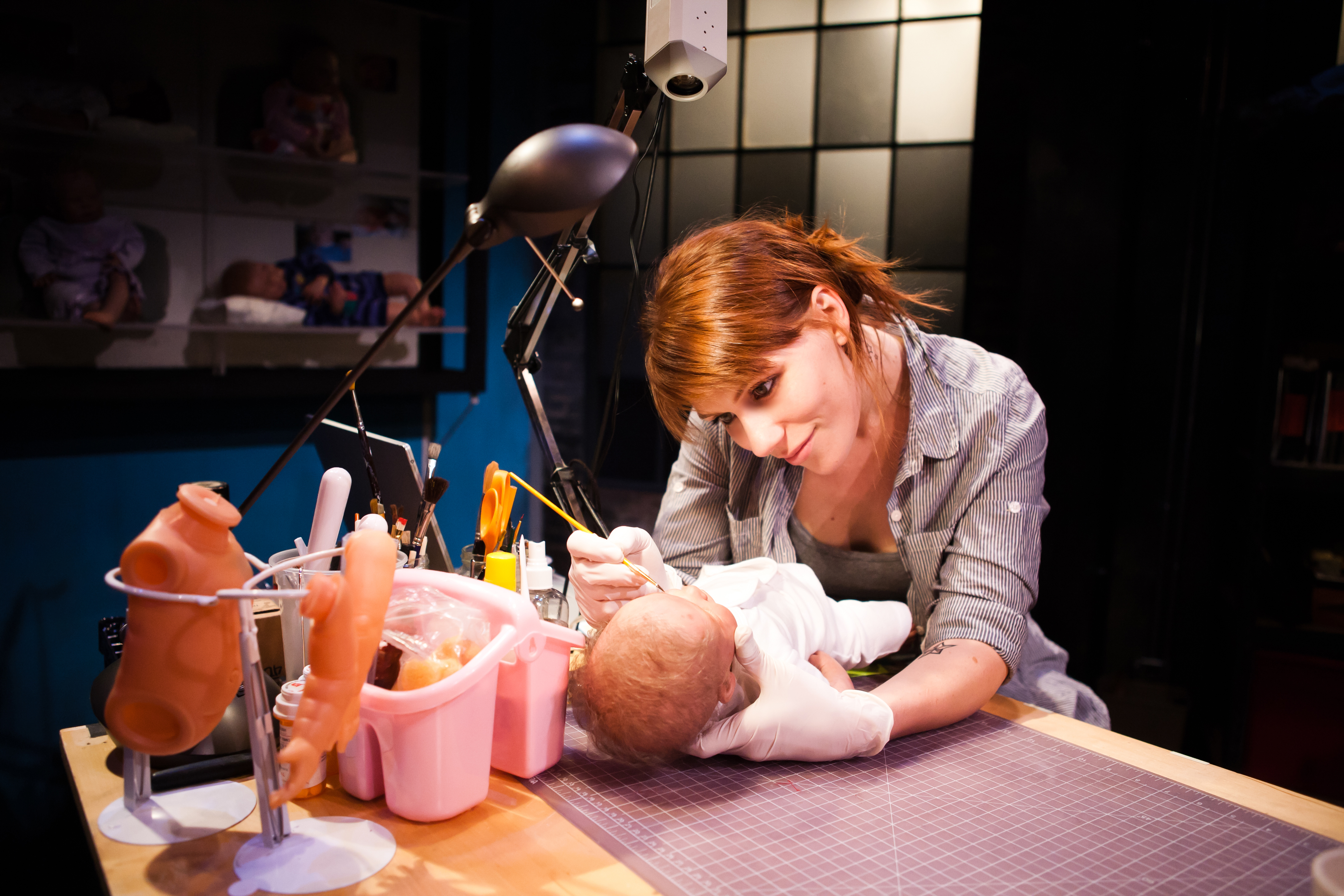
Lauren and Baby Eva in Reborning by, Zayd Dohrn at SF Playhouse. Photo: Jessica Palopoli

It is a bit tricky because time is always so limited with these processes—you want to feel like you can stop to ask questions, but you also want to be aware of keeping your mouth shut because you can spend up to two hours talking about one scene.  You have to get through the play and ultimately it’s about the play and not about your individual part—you have to be aware of both.  It’s hard."

USE YOUR INSTINCTS!
"Some actors are really best when they have time to process the play, time to go through all the emotions and everything that’s going on.  And other actors (like me!), usually find that the first instinct is the right choice. It’s important in these readings to go in and make decisions, but also be open to what the director’s going to say."

LET GO OF EGO
"Honestly, the best attitude to have in a staged reading or a workshop of a new play is the willingness to try anything, willingness to let go of your own ideas, willingness to let go of your ego.  It’s not just about the actor, and yet it is—you obviously can’t do a staged reading without actors. But it’s really important that you be willing to put your own ideas and feelings aside to honor the process of developing a script."

AND LASTLY,
"It’s an insanely gratifying experience to be a part of something as it’s being formed."


You can catch Lauren's performance in Geetha Reddy's new play Girl in a Box on Monday, November 28 at Stanford or on Tuesday, November 29 at the Thick House in San Francisco.  Readings are FREE with a suggested $10 donation.  Bring a friend and join the fun!  More info here.

Look out for our next interview with director Jessica Heidt here on the PF blog!