Monday, November 21, 2011

Jessica Heidt in a Box

By, Caitlyn Tella

Today we zone in on Jessica Heidt, new play director extraordinaire, and the woman at the helm of Geetha's Girl in a Box Rough Reading. Jessica built a career on her passion for new and experimental theater, directing and producing countless readings, workshops, and theatrical events throughout the Bay.  I spoke with her briefly about the world of possibility--that is, the world of new plays--and here are the words from our conversation:

Can you talk a little about the story of Girl in a Box?
Yes. The story begins with an event that happens in childhood.  There are mysterious circumstances around the disappearance of Sally, Ava’s best friend, when they are about 10 years old.  The rest of the play follows a lifetime, as we try to return to this event from childhood and figure out what happened.  Ava, played by Lauren English, ages throughout the story, and the other two actresses play multiple characters that lead us from scene to scene as the years progress.

The Lily's Revenge by Taylor Mac at Magic Theatre

I love when actors play multiple characters in one play. Is there an element of fantasy in this story?
Yeah, I think in many ways there are, whether it’s fantasy or dream.  There are definitely moments of suspended reality.
Miriam Wolodarski in her show Lavinia at Climate Theatre

Your theater company, Climate Theater, creates a space for experimental performance, and as a director you often work on original plays.  Could you talk about what draws you to producing and directing new work?
It’s the sense of possibility, with all of these different types of work.  With new plays in general, I love working with writers, and I love being able to help someone realize their vision.  As a director and producer in these settings, I can add my own sense of theatricality and story and character, and be part of the burst of these new projects.  I find that incredibly exciting. It’s great to have a playwright in the room, like Lauren said, to be able to wrestle big questions.

Orestes 2.0 by Charles Mee at USF

As a producer at Climate, I was able to work with such a wide range of artists—I had composers, people from physical theater, at one point I had a filmmaker—who I loved and respected.  I was really excited by the work they were creating, but they didn’t necessarily have a space to do it, so that’s what I was able to give them.  And at the same time, because many of the artists I was nurturing were part of a residency program they all got to know each other and they inspired each other’s work. A lot of times they became collaborators, and that was so much fun to watch grow.

Danielle Levin, Patrick Alparone and Michelle Maxson
Man of Rock by Daniel Heath at Climate Theatre

Do you ever begin your process by gathering your favorite artists, say a video artist, choreographer, and actors, and basically start from scratch that way?  Or is it necessary to have an idea and then gather people?
As of now, in general, the projects have been one person’s idea and then other people enter as they bring their own collaborators.  But I’ve always wanted to do what you’re talking about.  Maybe the next one!

Could be interesting.  Could be a lot of work.
(Laughs) And so much fun.
Summer Shapiro (resident artist at Climate) in her show, In the Boudoir


All photos from Jessica or Jessica's website: www.jessicaheidt.com

Don't miss out on Girl in a Box! It's going to be amazing.  If you prefer the Peninsula, you can catch it next Monday, November 28 at Stanford or if San Francisco is more convenient, come Tuesday, November 29 to the Thick House in Potrero Hill.  This reading, like all of our Rough Readings is FREE with a suggested $10 donation.  Bring a friend, your significant other, your OK Cupid date, or enjoy an evening of theater in solitude (paradox?).  More info here.

Friday, November 11, 2011

Lauren English in a Box: Digging into the new play process from the actor's perspective

By Caitlyn Tella, PF Volunteer
At PF we develop new plays.  So, what does that mean, anyway?  What's the difference between nurturing a new work and producing a full-on show?  Here, I will look into these questions by interviewing the artists behind our next Rough Reading, Girl in a Box, written by resident playwright Geetha Reddy and directed by Jessica Heidt. First up is a look into the actor's experience, through the eyes of Lauren English, who will be playing "Ava" in the reading. 

Lauren English

From her days at NYU Grad Acting to her recent performance in Claire Chafee’s Why We Have a Body at the Magic, local actress Lauren English has often worked directly with playwrights on their scripts.  As an actress myself, I’ve never had this opportunity, so I wanted to get some insight on what it's like to perform in a staged reading.  Here is some of the wisdom Lauren shared with me:
IT’S NOT REALLY ABOUT YOU J
"Doing a staged reading requires you to extend a sensibility outside of yourself, because what you’re ultimately doing is giving the play the best reading possible so that the playwright and the producers and the director can hear it.  I always feel like it’s my job to do the best reading of the play that I can so that the playwright can continue to work on it."

ACTOR-PROOFing
"In rehearsal for a staged reading my role is to point out the things that aren’t actor-proof.  For example, a good actor can make a bad line work, but I don’t feel like that ultimately serves a reading or workshop of a play because what you want to do is make it actor-proof. The lines must be so clear and succinct that an inexperienced actor could encounter a line and know what to do with it. As an actor, you don’t want to try to save the play by interpretation."

I SEE A VOICE
"The last play I did where the playwright was in the room was Why We Have a Body and the most exciting thing is getting to hear the playwright’s voice in the room.  You have the chance to ask, “I’m not really understanding this section of the play—why does she make this decision?” Most of the time, and certainly with Claire Chafee—she would go into the storytelling mode and talk about these characters as if they were real people.  All of a sudden this mystery becomes a totally specific reality, and that’s thrilling.  There’s something super exciting about having the person who created this character tell you about her. It can really make your work more specific." 

BATTLING THE TIME CRUNCH
"It’s important to spend as much time as possible with the script before rehearsals start. Read the script and identify any major questions that you have about the story, so that you can come to rehearsal and say, “Okay, I know we don’t have much time but I just want to make sure I’m clear—in the second act she does this, she makes these choices, is that what I’m feeling here?”  In that regard you’re at least being as clear as you possibly can, story-wise.

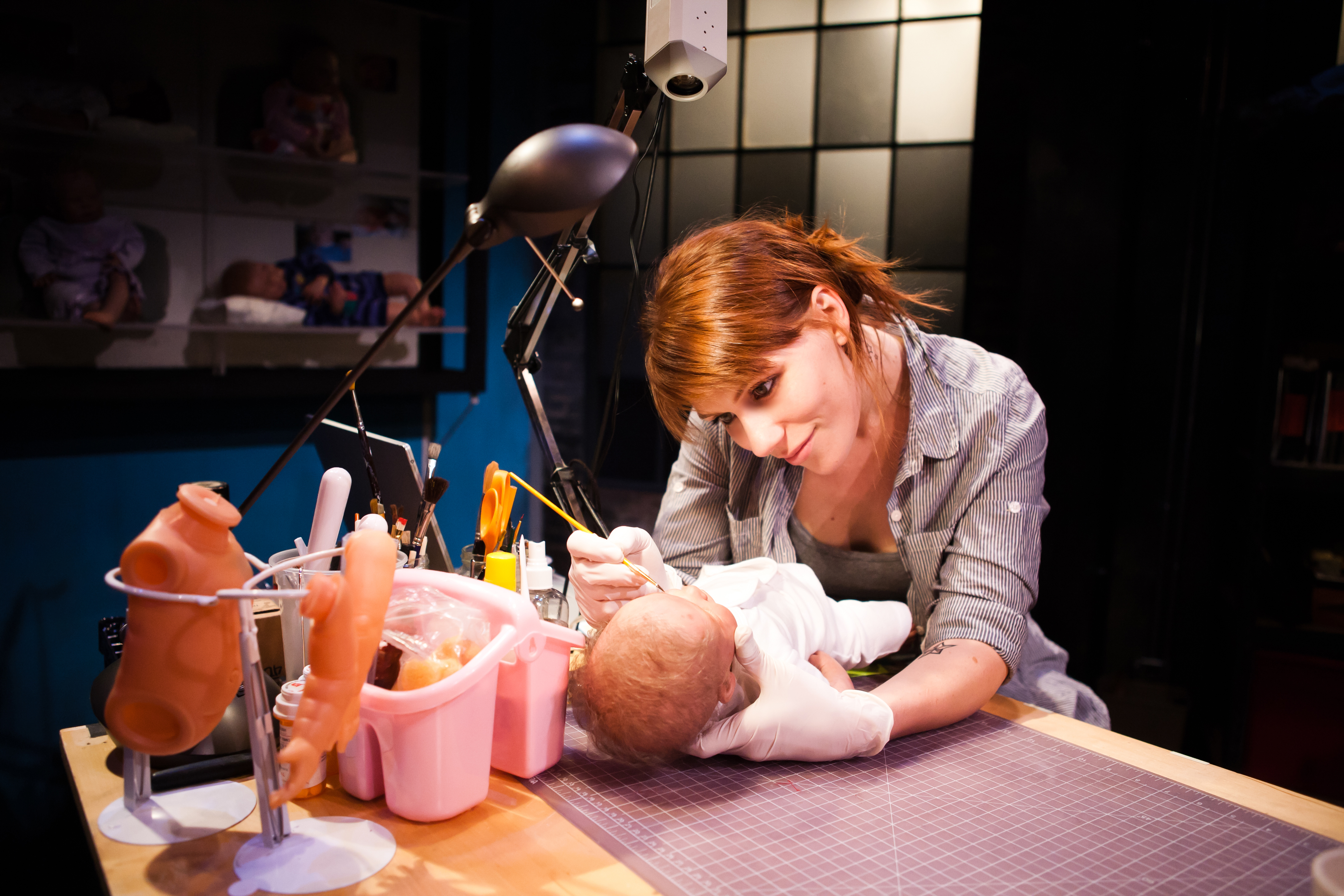
Lauren and Baby Eva in Reborning by, Zayd Dohrn at SF Playhouse. Photo: Jessica Palopoli

It is a bit tricky because time is always so limited with these processes—you want to feel like you can stop to ask questions, but you also want to be aware of keeping your mouth shut because you can spend up to two hours talking about one scene.  You have to get through the play and ultimately it’s about the play and not about your individual part—you have to be aware of both.  It’s hard."

USE YOUR INSTINCTS!
"Some actors are really best when they have time to process the play, time to go through all the emotions and everything that’s going on.  And other actors (like me!), usually find that the first instinct is the right choice. It’s important in these readings to go in and make decisions, but also be open to what the director’s going to say."

LET GO OF EGO
"Honestly, the best attitude to have in a staged reading or a workshop of a new play is the willingness to try anything, willingness to let go of your own ideas, willingness to let go of your ego.  It’s not just about the actor, and yet it is—you obviously can’t do a staged reading without actors. But it’s really important that you be willing to put your own ideas and feelings aside to honor the process of developing a script."

AND LASTLY,
"It’s an insanely gratifying experience to be a part of something as it’s being formed."


You can catch Lauren's performance in Geetha Reddy's new play Girl in a Box on Monday, November 28 at Stanford or on Tuesday, November 29 at the Thick House in San Francisco.  Readings are FREE with a suggested $10 donation.  Bring a friend and join the fun!  More info here.

Look out for our next interview with director Jessica Heidt here on the PF blog!

Saturday, August 13, 2011

Accepting My Voice

by Thais Harris

Really good incentive. That’s what I need when I start thinking that my voice is not clear enough, clever enough, brilliant enough. Good incentive, attention, and inspiration – that is what I got from Bill Cain’s class at the Playwrights Foundation. These things are bound to get me off my butt (well, actually, on my butt) writing. That someone outside of my head might just get a glimpse of what’s going on in there, and say “that’s great, I get it, now make it more accessible, and immediate.” That someone so much further along than me can hold my hands and say “one, two, three” and lift me up from the ground, keeping me suspended for just a minute while I realize I can step down on my own two feet. This is keeping me writing. This is bubbling in the middle of my heart, reminding me that I am a worthy messenger.

Four days were not enough, but they were enough to have a big impact. Eleven writers came together to learn from Bill Cain how to fulfill the sacred duty of finding their own voices. Our own voices. Bill is one of the most talented writers I know, as well as a Jesuit Priest, a 6th and 7th grade teacher, and a self-proclaimed anger instigator (though with his sweet demeanor this is hard to fathom). He listened patiently, thought about work outside of the class, held the space for us to share it, researched companion pieces, and offered honest criticism and insight.

There were those of us who already had a clear picture of their next play in mind, or were already pretty confident in their style. And there were also those of us, yours truly included, who had a notion of a theme, but felt a long way away from developing it into a truthful, gripping, piece of theatre. There’s certainly much more work to be done, but in the course of four days - by visiting the Bible, Shakespeare, Cinderella, and sharing our work out loud - we were able to walk out with a tangible dramatic question, a clear outline, and a chart of our beautiful, imperfect, unique sound.

We practiced performance and collaboration by singing;
We explored the world of theatre by reading, discussing, and comparing our favorite plays;
We looked beyond the 10 commandments and found the small print that says we have a responsibility to find our voice,
We accepted we don’t have to ask permission, and that it is up to us to realize that what we are doing is great;
And we trusted – each other with our stories, and ourselves with the ability to tell them.

The dedication with which Bill guided us was moving, and the huge steps people took in their work were inspiring. When he posed the questions “Do you think that what you have to say is worth saying; can you say it; and can it be received?” We couldn’t help but bring our most honest voice forward. And now I can’t help but write.
Aug. 1, 2011

Thais Harris

Graphic & Web Design
thais@thaisharris.com <mailto:thais@thaisharris.com>
www.thaisharris.com <http://www.thaisharris.com> <http://www.thaisharris.com>

Wednesday, July 27, 2011

The Retreat


by Chinaka Hodge

It was sort of like the greatest summer camp, ever.

Here are the facts: Last week, in Danville CA, seven playwrights, seven dramaturgs, seven directors and a handful of Playwrights Foundation representatives went on a retreat. The retreat was in preparation for the 34th Annual Bay Area Playwrights Festival (BAPF). My newest work 700th & Int'l is going up in this festival. As a participating playwright I was required to attend the retreat. I rolled my eyes a little and mentally prepared myself.


If you're anything like me, when you hear the word "retreat" you think of time wasting team building exercises, mediocre food and a whole lot of feigning interest in half-baked motivational speeches. But the BAPF retreat couldn't have been further from that. I sort of think that next time they do this getaway they should just call it "awesome, much needed, distraction free, writing time for television addicted playwrights like yourself, Chinaka". Or "an outstanding gathering of some of the nations brightest and most inspiring theater makers that will certainly make you cry with their brilliant plays, Chinaka".

Okay, fine. Those names don't really roll off the tongue or fly from the fingertips, but those names are more accurate, I believe. Begrudgingly, however, and in the spirit of brevity, I'll concede the name. We went on a "RETREAT".

The core of this time away was having the opportunity to hear every playwright in the festival read their works aloud. In my decade or so making work for the stage, never have I undertaken such a feat. To read every word of my short script meant roughly an hour of speaking aloud. I have to admit that I was daunted by the idea of sharing my (then) unfinished script with a room full of people I'd never met. I decided to grow a pair relatively quickly, though. Once Clarence Coo, the first playwright to share, rocked every notion I had about the way language could and should work on stage, I was hooked. I was hooked on the language alone. Lauren Gunderson's command of the norms and linguistic brilliance of the southern twang in Rock Creek: Southern Gothic; Amelia Roper's refined simplicity with Hong Kong Dinosaur's dialogue; and the phonological specificity of Dan Dietz's Home Below Zero was enough to make me wish the retreat and festival were both twice as long. As the days went on, I wanted more and more to stay. To stay, and to write. And to think and to cry. And to listen. To have my soul gently swayed by the words of others. To pull the pencil from behind my ear and to jot another note on how to become a better writer, as demonstrated by my peers. I talked to my boyfriend on the second night away. He asked me how it was and I replied that it was the greatest summer camp, ever.

(In the interest of total disclosure, I had the East Bay's best cookie in the cafeteria of the retreat site, and the promise of consuming more was probably enough to keep me there for a week or so. There were also Red Vines, and if you know me, you know I have a weakness for the lanyard-like confection).

But like all fantastic summer camp experiences, we packed up our pillows and knapsacks and headed down the hill. Down the hill and back towards the sparkling city across The Bay. We're gearing up for the two-week festival. If you've read this blog post this far, I bet you're a fan of theater and words and probably of run-on sentences. If you like any of that, you should come to see these shows. Check out my little diddy 700th & Int'l at BASH! if you have time. MAKE TIME to see the works of all of the other playwrights. I promise that the 34th Annual Bay Area Playwrights Festival is the best yet, and I wouldn't want you to miss out. I look forward to seeing you jaw dropped and inspired, as I was.

--------------------------------------
For more info on Chinaka's play 700th & Int'l and the BASH section of this year's Annual Bay Area Playwrights Festival visit playwrightsfoundation.org

Thursday, July 21, 2011

Interview with Kate E. Ryan

Kate E. Ryan’s Science is Close [click here] is one of the two plays featured in BASH! (Bay Area SHorts) for this year’s Bay Area Playwrights Festival. Kate is a Bay Area transplant from New York and has worked on numerous plays including an adaptation of Sophocles' Women of Trachis. Science is Close represents the second in a trilogy of plays Kate has written about the character Dot. We at the offices of Playwrights Foundation had a chance to catch up with Kate during the hustle and bustle of the Festival.

Could you briefly explain the genesis of your play Science is Close?
I began Science is Close in the fall of 2009, when I was living in Brooklyn. I was Co-Chair of Soho Rep’s Writer-Director Lab for several years and that job included the opportunity to write a new play in the Lab each year. For the ’09-’10 cycle I realized I wanted to continue the story of this elderly woman named Dot who is the main character in my play Dot – a work I had been developing for several years prior.
I also wanted to try to break out of some habits in my writing that I wasn’t happy with. I wanted to try to limit the amount of characters I could put into a play, and also stretch myself in terms of tone, humor and honesty. In Dot some of the characters are a little bit outsized and I wanted to work with characters that the audience could empathize with in a closer way.
Content-wise, my husband had been reading some material by Ray Kurzweil about “the future” and we had a conversation about life expansion -- the potential of healthcare technology to advance to the point that we could live to be, say, 150. I felt daunted by the idea of having to re-shape a vision of my lifespan. Then I heard an episode of This American Life called “Mistakes Were Made” about the early years of cryonics, and I started reading more about cryonics. I thought it would be interesting to have Dot as an elderly person who has lived a very eventful life grappling with the notion that she could have more life – if she wants it. It’s basically a play about whether she wants it – or not – and whether it’s okay for her to want it – or not.
How has this experience with the festival and Playwrights Foundation been? Honestly.
This experience has been wonderful so far. I’m excited to see all the readings in the next couple of weeks. I’m excited to have a work presented in the Bay Area for the first time. I’m excited to be one of the local writers in the Festival. As much as I miss my community of theatre makers in New York (I just moved to San Francisco last fall), I was really ready to break out of the NYC theatre world and move to a new place. This move has been freeing in terms of imagining what my writing could be and who my audiences could be. The Playwrights Foundation is an amazing organization that has been supportive of me right from the start – and for that I feel extremely lucky.
I’m also loving the Bay Area in general. I think there’s a calmness here, a baseline of contentedness in the population that does not exist in New York (the stereotype of the harried, wheels-churning New Yorker holds some truth). Now that I don’t have that rush of city life I’m able to focus more on the tasks at hand. In my writing life, I don’t feel as distracted.
The great August Wilson said many times before he died that the theatre must belong to the playwright to survive. Do you think this is true? 
It depends on what kind of theatre you’re talking about. I’m a playwright who often incorporates music and movement into my plays. Theatre can be linear narratives about characters who are specific, with whom audiences can empathize, in which we watch a protagonist change in some way… or it can be Elevator Repair Service’s adaptation of a modernist novel, or it can be Young Jean Lee’s bold work (that she directs) that doesn’t tell any kind of traditional story. The kind of theatre that audience members expect to see when they pay $40-$140 per ticket might need to belong to the playwright in order to align with a common sense of what theatre is, but I think the most exciting performances – the ones that express a new way of seeing -- come from visionaries whose work may or may not be focused on an original text that they’ve created. They are often working against something in the theatre that they feel is causing the theatre to die.
 Audiences are smart. They experience fractured narratives daily just by going online and they watch television shows that play daringly with form. In order for theatre to survive it has to be in the hands of theatre artists of any discipline who are keyed into what will rattle audience members’ brains now.
 And lastly, what do you hope to do next in your life in the theatre?
 I want to keep discovering forms for the kinds of stories I want to tell.
 The artists who are actively engaged in the world -- in pop culture, technology, literature, current events – tend to make response-worthy work. So in my next life in the theatre I hope to continue to be engaged in life outside the theatre.
 I look forward to getting to know more about the Bay Area theatre world. I look forward to shedding some of my New Yorkiness (I lived there for 14 years) that is negative and holding on to that which is positive. I look forward to staying close with my NYC theatre community while building a network here. I want to continue to be involved with new play development for other writers.